XG Series - Model Specifications and Configurations
From success to new solutions
Derived from the huge success established with our universal transmission shafts, we introduce the new line of EPR gear couplings: XG Series.
The XG Series gear couplings are manufactured and available in AISI1045, AISI4140 hardened and tempered steel or in AISI630 stainless steel. Equipped with 12.9 class structural bolts, stainless steel grease nipples and NBR or Viton rubber sealing o-rings.
Maximum allowable misalignment:
Standard Series: 0°10'
With heat treatment: 0°15'
Operating Principle
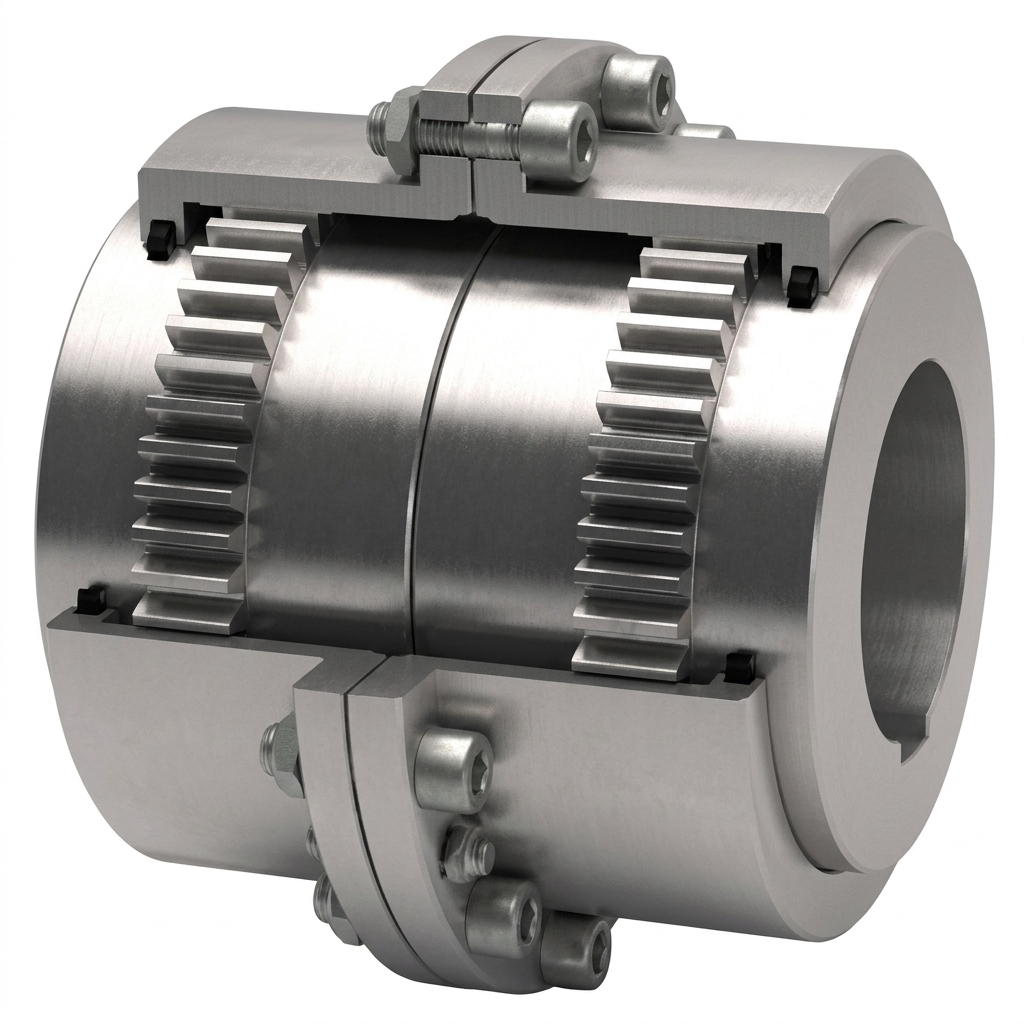
The operating principle of the gear couplings illustrated synthetically in the adjacent figure is based on the meshing of the external teething of the hub with the internal teething of the sleeve (or bell), which allows the transmission of torque between the flanges.
The relative misalignment is compensated by the axial sliding of the internal toothing on the external toothing. By means of the crowned teething, our couplings ensure optimal and torsionally rigid connections between the most diverse devices, even with moderate misalignments, axial and radial displacements.
The crowned inner teething of the EPR XG series gear couplings has been designed to ensure misalignment conditions over larger contact surfaces. The deviation of the utilized profile determines the increase in the thickness of the tooth and therefore the resistance of the teething itself.
Cookies are small text files sent and memorised on your computer and generated by the web sites you browse. Cookies are memorised on your computer's hard disk drive and help the website remember information that is useful to your browsing. This is done to make any future visits easier and quicker.
Visit Aboutcookies.org for further information on cookies and how they impact your navigation experience.
Types of cookies
Indispensable technical cookies They are essential for proper website operation. Without these cookies proper operation of some functions may be compromised thereby limiting access to contents. No personal information of the user is collected by this type of cookie.
Technical Cookies for functions These cookies are used to memorise the choices made by the user to optmise and improve navigation (for example, the language chosen or pre-filling a form with a name that has already been used). This type of cookie may include the user's personal information (eg. user name). Without these cookies a number of functions and navigation through pages may be compromised.
Analytic Cookies These cookies are used to gain insight into how visitors use the website: if they are first-time users or visitors returning to the website, how visitors move between pages, how long they stay on pages and on the website, their geographical area of provenance. These data do not identify the user personally but are aggregated anonymously by analytic tools. Disabling this type of cookies in no way compromises proper operation of the functions offered by the website.
Social widget cookies Some widgets, which some social networks make available (for example Facebook, Twitter, YouTube, Google Maps, etc.), may use their own cookies (third-party cookies). Disabling these cookies will not compromise operation of the website, if not in the sections where the widgets are set (for example for embedding videos or maps), where a quick sharing of contents is permitted or where website contents can be commented on.
Profiling cookies Profiling cookies are set to show visitors to the website those contents that are related to their preferences. They can therefore be used to show advertising contents aimed at that person's interests. This type of cookie operates in collaboration with third party websites and can keep track of navigation history on pages appearing on different domains. This type of cookie usually keeps track of the user's IP address and other personal information. WE DO NOT USE this type of cookie on our website
Cookie duration
Session cookies These are temporary in-memory files which exist only while the user navigates the website and are deleted when the user closes the browser.
Persistent cookies These files are stored and maintained and do not expire when the website is abandoned or the web browser is closed. They are deleted at a specific date shown in the cookie itself.
Cookie domain
First party cookies These files are set on the user's device directly by the website the user is navigating.
Third party cookies These files are set by external websites, through the code embedded in the pages of the website the user is navigating. Examples of third party cookies are those set by social plugins (for content sharing) or analytic cookies collecting data on visits to a website.
How to disable cookies
The user can decide whether or not to accept cookies by using the browser settings.
Please note that disabling third-party cookies in no way affects navigability.
Please find hereinunder the links explaining how cookies are disabled in the most popular browsers:

 EN
EN
 Italiano